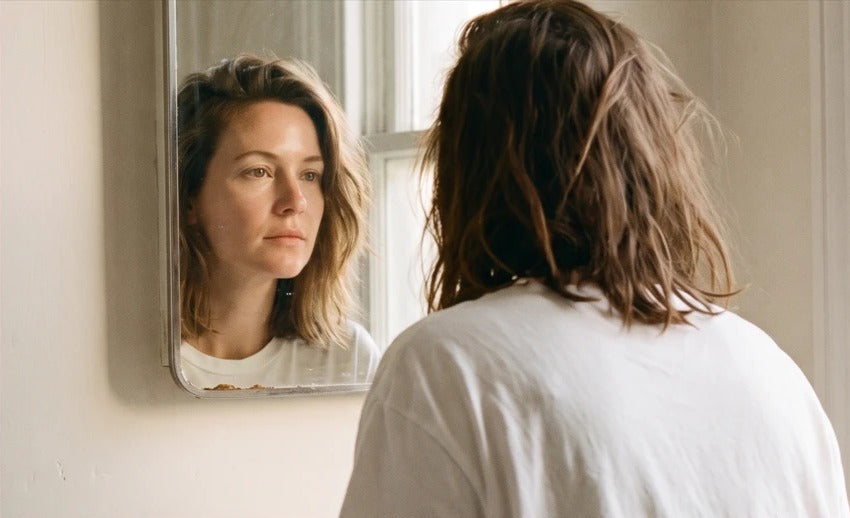
Someone asked me if I was doing well.
It was a Tuesday, around nine in the morning, and I had slept for nine hours. Nine. I had gone to bed early on purpose, which, for me, is practically an achievement. And a colleague had looked at me from the other end of the kitchen while the kettle was boiling and asked me, in that cautious voice you use in such cases, if everything was alright.
I told her that everything was fine. Everything was fine. And I spent the rest of the day trying to figure out, without saying a word, what she had seen.
The role I had been assigned
This is the part I have never said out loud to anyone.
At some point, in the span of about three years, without anyone deciding it, I had become the tired one. The one who, in the group photo, looks like she just came from somewhere. The one who says “sorry, I look terrible today” before anyone has made the slightest comment, because getting ahead of it hurts less than hearing it.
I did it often. I showed up everywhere apologizing for my own face. Stand-up meetings, birthdays, dinners at my sister’s. Sorry, long week. Sorry, haven’t slept much. Sometimes it was true and sometimes it wasn’t, but the phrase came out anyway, because I had stopped expecting to look like someone who had slept well.
And I had tried the obvious things. More sleep, even though I already had enough of it. More water, which mostly meant getting up even more at 3 a.m. I had cut back on wine, taken my phone out of the bedroom, bought the overpriced pillow. Nothing had changed. So, at some point, I quietly filed it away in the box of things that happen in your thirties, and I stopped trying.
That is what still bothers me. Not the fatigue. The fact that I had accepted it.
What She Had Really Seen
That night, when I got home, I did something a little crazy: for about a week, I looked at my face, really looked at it, in the morning, on purpose.
And what I had on my face wasn't fatigue. It was a line. Or two, running down from my cheekbone, exactly where my face had pressed into the pillow, still slightly visible at nine in the morning. Plus hair that had clearly been through a battle. Flattened on one side, frizzy in the front, and a knot at the base of my neck that had to be negotiated rather than brushed.
That's what it read. Not exhaustion. Just eight hours of evidence.
It sounds like a small distinction and, honestly, it kind of broke me, because I had spent three years believing that I was failing at something internal. Sleep. Health. Aging. And it turned out that the story written on my face every morning came from something external to me, something I had never looked at even once.

What the mirror tells me now
I'm not going to sell you a miracle. What happened is much simpler, and frankly, more satisfying.
My face no longer spends the first twenty minutes of the day unwrinkling. What I put on at bedtime is still there in the morning, instead of ending up in bed. And the reflection I see in the kitchen at nine o'clock is finally that of someone who has slept.
I thought I was a special case. Then I saw Lilly's numbers: 92% of customers find their skin more hydrated, and 70% notice fewer fine lines and wrinkles. I wasn't tired. I was just on the wrong pillowcase.
And that changes tonight.

What I had never questioned
I thought the night was neutral. Eight hours where nothing happens.
That's not the case. Every time you turn over, your hair rubs against whatever is underneath, and cotton is not a passive surface. Independent tests conducted by TRI Princeton have shown that cotton creates about 51 % more friction on hair than 22 momme silk. It's the frizz and the knot at the nape of the neck, which accumulate silently, night after night.
Cotton also absorbs, because that's its whole purpose. Perfect for a towel. Much less so when it's pressed against your face for eight hours, where it doesn't distinguish between sweat and what you put on your skin before going to bed.
And it catches. That's why my face still retained the shape of the pillow at nine in the morning.
So I spent sixteen hours taking care of myself, and then let everything go for the other eight. Every night, on a surface I had never given a single thought to, because it didn't look like a step in my routine. It looked like a bed.
22 momme silk is dense enough that hair glides instead of snagging, it absorbs far less of what you apply, and it doesn't leave your face set in a single folded position all night. It's not a treatment. There's nothing to apply and nothing to absorb. It removes an obstacle that was already there.
Shopping was the worst part
I'm warning you, because I almost bought the wrong one.
All the silk pillowcase pages say exactly the same few words. 100% mulberry. 22 momme. Grade 6A. OEKO-TEX. I had four tabs open. The cheapest at €32, the most expensive at €109, and not a single page explained the difference.

None of it can be verified. You can't see the mommage. You can't feel the grade. You're trusting a label written by the person trying to sell it.
Then I discovered that the biggest brand in the category publishes a warning: other brands claim a false mommage, and it guarantees its own measurement. Read that again. The market leader has to publicly declare that it isn't lying about its own flagship figure. That says a lot about the unverifiable part of this entire aisle.
So I stopped looking for silk and started looking for someone who would tell me things before I had to ask. Lilly puts the weight, grade, certification, origin, and washing instructions on the product page: 22 momme mulberry silk, grade 6A, Oeko-Tex® certified, finished in France, machine washable at 30°C. Not hidden three clicks away in a FAQ. On the page.
That's the only reason I chose it.
What Really Changed
It took about two weeks, and it was nothing spectacular.
The line on my cheek, which lasted until mid-morning, eventually disappeared before I had finished getting dressed. My hair stopped showing up in a mess at breakfast. The knot at the back of my neck stopped forming, which I still find vaguely ridiculous.
But what I really noticed was months later, at my sister's, when I realized that I had walked in, sat down, and hadn't apologized for my face. I hadn't taken the initiative. I hadn't needed to.
I want to be careful here, because I'm not telling you that a pillowcase changed my life. It didn't. What it did was take away something I had been silently apologizing for, which turned out not to be my fault, and that I could have stopped three years earlier for less than sixty euros.
That's what touches me. Three years.
What I would buy
I started with one. I have four now, for a very simple reason.
Two on the bed, two in the wash. It's the only system that withstands real-life laundry, because if you only have one, every time you make the bed, you end up directly on cotton, and you'll notice.
The math is simple. One costs €59.99. Two cost €95.99, which is a €23.99 saving. Buy three and the fourth is free: the set costs €179.97, which is €44.99 each. The one that spends its life in the laundry basket costs you nothing. Once I realized that, buying just one seemed a bit absurd.

Two sizes, both in French dimensions: 50 x 70 rectangle or 65 x 65 square. Measure your pillow first. That’s honestly the only thing you can get wrong.
Give it fourteen nights. Not because something happens on the fourteenth night, but because that’s about how long it takes to stop dreading your reflection, and you only notice it after the fact. And as for returns, you can send back your order free of charge within 30 days.
I’m not tired anymore. I never really was.

22 momme silk pillowcase
Fabric: 100 % 22 momme mulberry silk, grade 6A
Certification: OEKO-TEX®, tested for harmful substances
Care: machine washable at 30°C
Recommended item: special silk wash bag
Clinical Outcomes
94%
noticed less frizz and breakage
92%
found their skin more hydrated
74%
slept better
70%
noticed fewer fine lines and wrinkles
LILLY
Lilly is a French silk brand dedicated to sleep and beauty. Silk pillowcases reduce friction and moisture absorption compared to cotton. They are not a treatment for hair or skin.